
Is a Ceramic Coating the Right Fit for Your Daily Driver?
A ceramic coating can change how paint sheds water, releases grime, and responds to washing, but it does not make a daily driver damage-proof or maintenance-free. The useful question is whether those changes fit your paint, parking conditions, wash routine, expectations, and ownership plans.
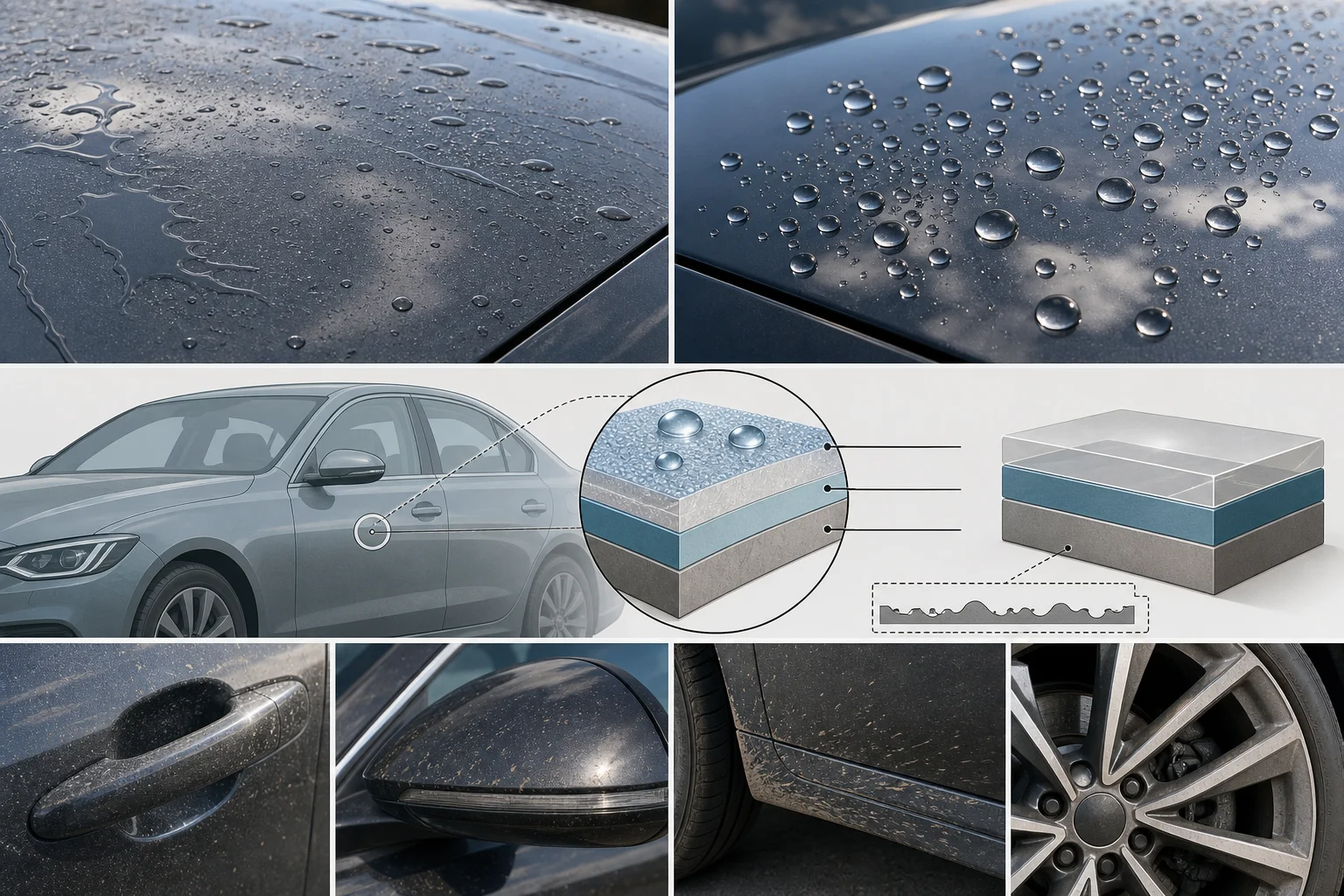
Two Similar Cars Can Lead to Opposite Coating Decisions
Picture a hypothetical pair of similar daily drivers arriving home after the same workday. Both have presentable paint. One owner washes carefully at home, dries the car rather than letting water sit, and removes fresh contamination when it appears. The other chooses whichever car wash fits the day and waits until dirt becomes obvious. Their cars may look nearly identical tonight, yet a ceramic coating could fit their futures very differently. The deciding factor is not the badge or mileage. It is the care each owner will realistically provide.
“Is ceramic coating worth it?” hides too many questions inside one word. Ask instead: “Which recurring paint-care problems am I trying to reduce, and what work am I willing to keep doing?” A coating may be useful if the goal is to make routine grime or some contamination less stubborn during proper cleaning. It will not solve an unwillingness to wash. Nor should it be chosen chiefly to prevent stone chips, parking-lot impacts, or deep scratches. Those involve physical forces that a thin surface treatment cannot reasonably be expected to stop.
The practical appeal is narrower, but still meaningful. A ceramic coating may change how water gathers and moves across paint. It may help some residue release with less effort, and different rinse behavior may make drying more manageable. Those changes can help an owner keep a daily driver looking consistently tidy. None is automatic or permanent. Road film still builds up, droplets can still dry and leave material behind, and bird residue still deserves prompt attention. Washing technique continues to matter because grit dragged across the finish can mark it whether the paint is coated or not.
Do not measure the coating’s value only by the gloss visible immediately after application. Paint may first be washed thoroughly, decontaminated, or corrected. Cleaning removes material sitting on the finish. Correction refines defects in the clear coat, which can account for much of the visual improvement. A coating may affect the surface’s later behavior, but it should not receive sole credit for preparation work. Installation-day appearance is a snapshot; the ownership test begins after commuting, outdoor exposure, and repeated car washing.
Six variables sharpen that test. Start with paint condition: sound but imperfect paint presents a different choice from neglected paint requiring extensive preparation or actual repair. Then consider parking environment. A garaged commuter, a car parked beneath trees, and a vehicle exposed to recurring water spray face different cleanup problems. Washing habits matter more than aspirational plans. Upkeep tolerance covers careful drying, contamination removal, and attention when surface behavior changes. Intended ownership period affects how often the owner expects to experience any benefit. Finally, appearance expectations may range from presentable at normal viewing distance to closely scrutinized under direct light.
These factors do not produce simple rules. Consider a hypothetical owner who parks outdoors but washes consistently and notices residue early. Frequent exposure may make easier cleanup especially valuable. Outdoor parking alone does not rule out a coating. Now consider a garage-kept car whose owner is satisfied with straightforward washing and an occasional wax or paint sealant. A more persistent treatment may add little that this owner values. Even two careful owners can choose differently: one may enjoy periodically refreshing a temporary protectant, while the other may prefer a surface treatment intended to remain through ordinary washing.
Expectations can turn a reasonable choice into a frustrating one. An owner seeking a modest reduction in washing effort may value a coating. Someone expecting immunity from scratches, chips, water spots, or neglect probably will not. “Protection” is too broad unless the claim identifies both the threat and the mechanism. Is the proposed benefit different water behavior, easier contamination removal, or resistance to a particular exposure? Is the discussion really about physical impact? These are separate behaviors. A dramatic demonstration of beading or slickness does not answer all of them.
The fair test is ordinary ownership. Notice what happens when lower doors collect grime, rain dries before the car reaches shelter, and washing must fit into a busy weekend. Does the surface require less repeated contact? Is rinsing or drying easier? Can the owner maintain it without resenting the routine? A ceramic coating earns its place only if it improves recurring tasks often enough to matter to that person. Wax, paint sealant, or carefully maintained uncoated clear coat can be equally rational choices. Similar cars need not receive identical treatment, because their owners are solving different problems.
The Thin Layer Above the Clear Coat—and What It Actually Does
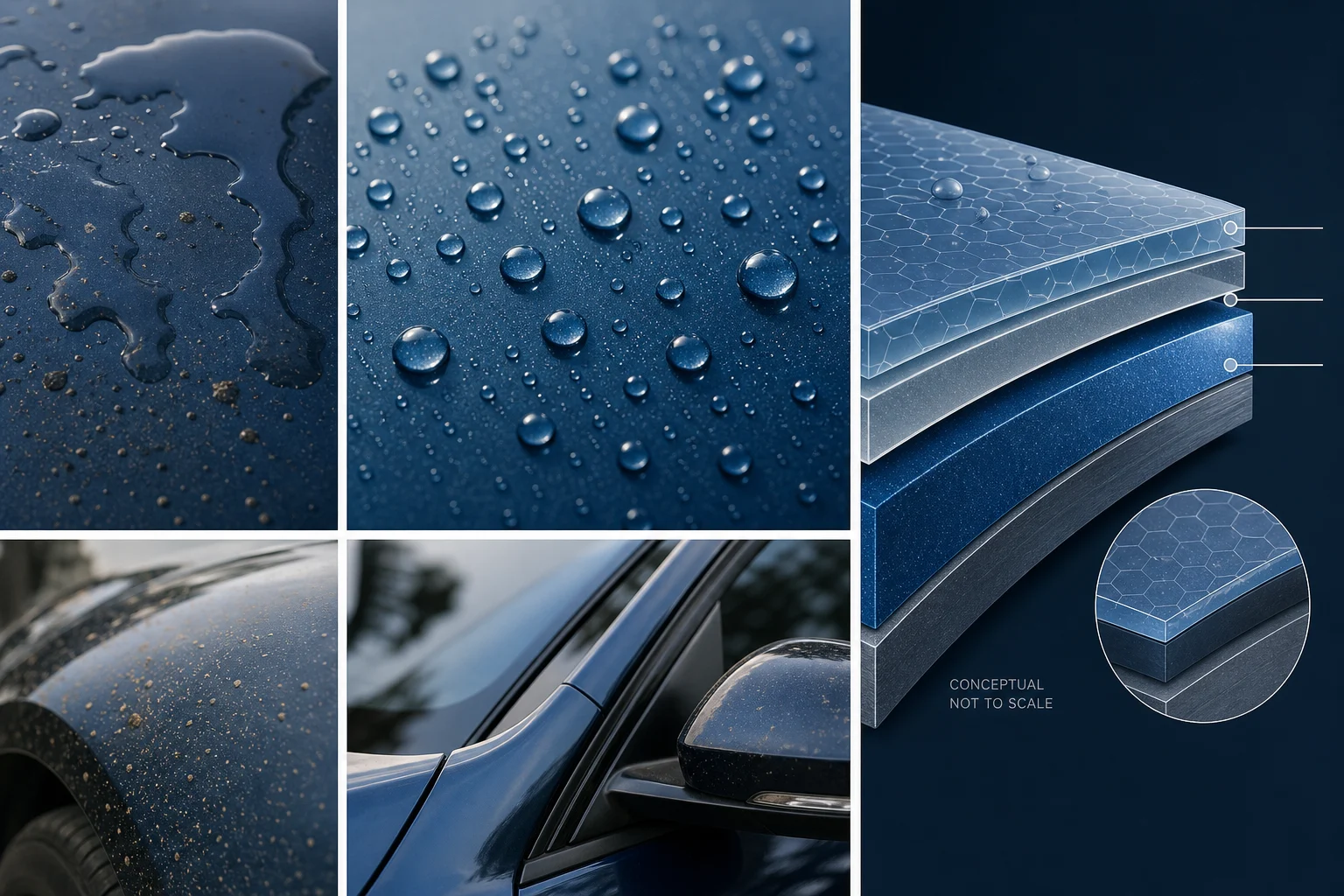
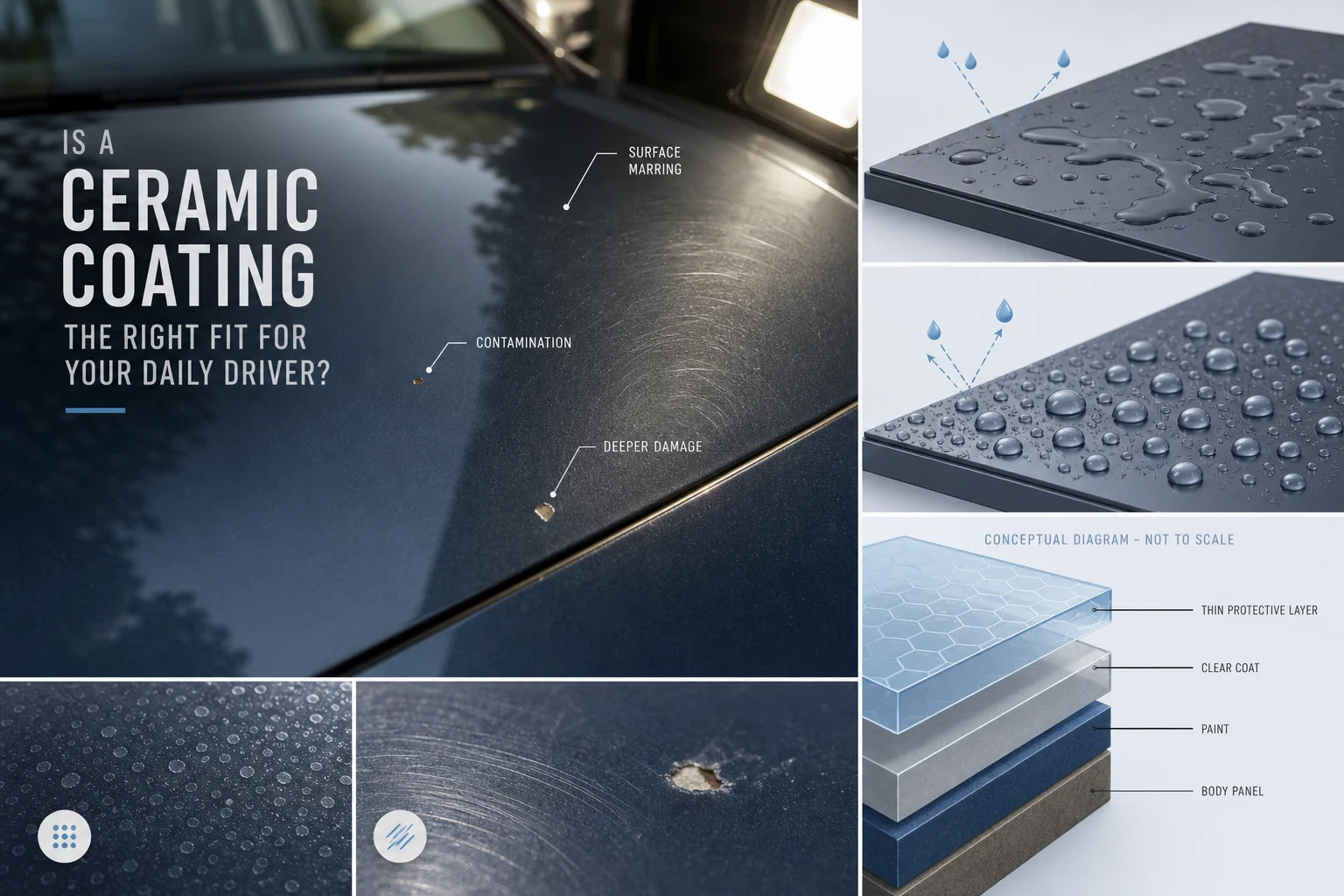
Start with a simplified cutaway through a body panel. The diagram shows the painted substrate, color layer, clear coat, and a ceramic coating at the exposed surface. It should also carry an unmistakable label: “Conceptual—not to scale.” A coating may need to be enlarged enough to see in an illustration, but that visual convenience can mislead. Drawn too boldly, it starts to resemble a thick shield rather than a thin surface treatment.
The clear coat remains the primary finished paint surface. It is the layer owners wash and, when appropriate, polish to refine certain defects. A ceramic coating sits above it and may change how water and some contaminants interact with the finish. It does not amount to a replacement clear coat, nor should its presence suggest that the body panel has gained a substantial new physical barrier. Its useful effects occur mainly at the exposed surface.
Terms such as “bonding” and “curing” often make a coating sound more structural than it is. For the owner, the practical point is persistence: the coating is intended to remain attached through normal car washing more readily than a temporary finishing product. That can preserve useful surface behavior without requiring the owner to recreate it after every wash. Persistence is not permanence, however. Because the coating occupies the outermost position, it receives grime, mineral residue, wash contact, and environmental exposure first. It still requires careful cleaning.
The word “protection” needs more precision. Chemical resistance, slickness, gloss, and physical impact resistance describe different behaviors. Chemical resistance concerns how the surface responds to a particular substance and exposure. Slickness concerns feel and, potentially, how readily some material moves across the finish. Gloss describes appearance. Impact resistance involves force. Better performance in one category does not establish better performance in the others. A glossy, water-repellent panel may be easier to clean while remaining vulnerable to a door edge or flying debris.
Consider a hypothetical stone striking the hood. That event concentrates force on a small area and may remove or deform material. A thin coating cannot reasonably be expected to absorb the strike like a substantial physical barrier. The same boundary applies when a sharp object or abrasive grit is dragged across the finish. If the contact has enough force to cut into the clear coat, the presence of a coating above it does not make that clear coat unreachable. Ceramic coating is not an answer to dents, stone chips, or deep scratches.
That limit does not make the coating pointless; it locates the benefit correctly. If water moves differently, some residue releases with less effort, or washing requires fewer repeated passes, the owner may experience a practical reduction in routine work. The coating can also serve as the first exposed surface during some contamination events. Calling it “sacrificial” means that this outer layer receives the exposure and may itself need cleaning, maintenance, or eventual renewal. It does not guarantee that the paint beneath it will remain unaffected.
Evaluate any protection claim by naming the event. If a coating is said to provide chemical resistance, ask which substance is involved, how long it remains, and whether the claimed benefit is easier cleanup, delayed damage, or complete prevention. If it is described as scratch resistant, ask what caused the mark and where the damage lies. A trace in surface contamination, a disturbance limited to the coating, and a cut into the clear coat are different outcomes. Grouping them all under “scratches” conceals the distinction that matters.
Use the same vocabulary check before deciding what you expect from a coating. What is the problem: water behavior, adhered grime, staining, wash marring, sharp contact, or impact? Which layer receives the event? Does the claimed benefit make cleanup easier, or does it truly prevent damage? A ceramic coating makes its clearest case when the desired change involves recurring surface behavior and maintenance. If the chief concern is force gouging, chipping, or deforming the paint system, this thin layer is being asked to solve the wrong problem.
Water Beading Is a Behavior, Not a Complete Protection Score
Picture a hypothetical driveway after rain. One hood wears compact, rounded beads; the hood beside it holds flatter patches that join into irregular sheets. The beaded panel makes the stronger photograph. It does not necessarily have cleaner paint, fewer scratches, or better resistance to impact. The droplets show how water interacts with that surface at that moment. They say little by themselves about what lies below or how the finish will look once the water dries.
A ceramic coating may change how water gathers and moves across paint. During rinsing, water may contract into beads, pull into streams, or leave sections of a panel more readily. Owners can use changes in that behavior as a practical maintenance clue. But it remains a clue, not a diagnosis. Surface cleanliness, lingering wash residue, panel shape, and other finishing products may also influence what the water does. A photograph of round beads cannot establish the coating’s overall condition.
The useful part becomes clearer during an ordinary wash. If rinse water moves readily down a door or off a hood, less may remain for hand drying. Forced air may move mobile droplets with less effort than broad areas of clinging water. That can reduce towel work, which matters to an owner who washes often and wants fewer drying passes. The benefit is conditional, though. Water can still collect on flat panels, around trim, and in seams before running out later.
Beading has its own drawback. A droplet that leaves the vehicle carries its water away; one that remains until it evaporates can leave dissolved material behind. The result may be visible rings or spots even though the panel displayed dramatic water repellency minutes earlier. Attractive beads are therefore not the same as a spot-free finish. Deliberate drying still makes sense when water remains on the vehicle, and especially where droplets repeatedly collect.
This is where a flattering demonstration can distort the ownership decision. It freezes the moment when water looks most impressive. Daily use continues through light rain, dusty parking, incomplete drying, and water emerging from a mirror or trim edge after the rest of the car is finished. A coating may help some water leave, but it cannot make every droplet depart before it dries. Judge the practical result after cleanup, not at the most photogenic point in the rinse.
Weak or uneven beading also does not prove that a coating has disappeared. Road film, mineral residue, wash-product residue, and other contamination may sit on top of the coating and become the surface that water encounters. One section may sheet while another holds tight beads simply because the panel is not equally clean. Begin with a careful wash and rinse. If expected behavior returns, contamination was likely masking it. If it does not, further inspection or a paint-compatible decontamination step may be warranted; aggressive scrubbing is not a useful test.
A better evaluation tracks several ordinary observations. Start with a clean panel, then watch how water leaves during the final rinse. Note how much remains for drying, where it lingers, and whether those patterns change across several washes. Check the finish itself for grime, dried residue, wash marks, chips, and scratches rather than trying to infer those conditions from droplet shape. When behavior changes, consider recent exposure and surface cleanliness before declaring success or failure. Water beading can reveal something about the exposed surface. It cannot serve as a complete score for ceramic coating performance or paint protection.
Where a Coating May Reduce Friction in the Wash Process
Saturday morning, rinse water carries loose grime down a coated door. Then the light catches the lower panel: a gray film remains behind the front wheel and along the rocker, where wet-road residue has settled and dried. More water may shift some of it, but the rest needs deliberate contact washing. That is the useful middle ground. A ceramic coating may help dirt release, but it does not turn a dirty daily driver into a touch-free-clean vehicle.
The pre-rinse has one job: remove loose material before wash media touches the paint. A coated surface may release some grime readily, leaving less behind for the contact stage. Still, do not interpret easier release as permission to attack stubborn areas. Dirt that remains on the panel can become trapped under a mitt, sponge, brush, or towel and dragged across the finish.
Contact washing is where a coating’s benefit may become most practical—and where careless technique can erase that advantage. If road film comes away with fewer passes and less pressure, the owner has less reason to scrub. That saves effort and reduces repeated contact. It does not make dirty wash media harmless. Grit caught between the media and the vehicle can mark the exposed surface whether there is a coating underneath or not. Clean media and adequate lubrication still do the protective work.
Wash manageable sections, checking the media as you go. When residue resists an ordinary pass, do not keep rubbing harder with the same material. Rinse or replace the media, apply fresh cleaning solution, and reconsider the problem. Loose dirt and bonded contamination are not the same thing. The latter may need a separate cleaning method rather than more pressure during a normal wash.
Clean water matters for the same reason. Once grime leaves the panel, the wash process should keep it from returning. Depending on the setup, that may mean rinsing the media thoroughly, changing contaminated materials, or retiring a towel after it has touched a particularly dirty lower section. Equipment can vary; the principle cannot. Do not put removed grit back against the finish.
The final rinse offers useful feedback. On a clean coated panel, water may move away readily, reducing the amount left for manual drying. Watch the whole panel rather than admiring a few beads. Water can remain around mirrors, handles, trim, and panel gaps, then emerge after the rest of the car looks dry. Droplets left on open surfaces can also dry and leave residue. If rinse behavior has changed, contamination on top of the coating may be responsible; sluggish water alone does not prove the coating has disappeared.
Drying calls for the same restraint as washing. Use clean drying materials and controlled contact instead of pressing harder or making endless passes. If suitable forced air is available, it may move water from gaps and reduce towel contact. But air is not automatically clean: equipment or nearby dust can introduce debris to freshly washed paint. Whatever the method, the aim is to remove water without adding dirt or needless friction.
“Easier to maintain” describes a series of modest gains. Road film may need less persuasion. The rinse may leave less standing water. Drying may take fewer passes. For an owner who washes regularly, those differences can make a familiar routine quicker and less frustrating. They are not permanent exemptions from cleaning. Dust, road film, and dried residue still collect on the outer surface, where they can hide the water behavior and slickness the owner expects.
Judge the fit against the routine you actually follow. If you already pre-rinse, use clean media, limit pressure, and dry carefully, a ceramic coating may make that process more efficient or somewhat more forgiving. If you postpone washing until grime is heavy, reuse questionable towels, or dislike washing altogether, the coating will not remove the chore. It may change how readily the car cleans, but it cannot provide the attention and technique that protect the finish during cleaning.
Contamination Can Become Easier to Remove Without Becoming Harmless
At lunch, a hypothetical owner notices fresh bird residue on a roof that has been sitting in the sun. The next full wash is days away. A ceramic coating may help the residue release during proper cleaning, but postponing removal still asks the outer surface to tolerate an unknown material for longer. The sensible move is prompt, gentle cleanup with suitable cleaning solution and clean, soft material—not dry rubbing or hurried scraping. Coated paint is not contamination that can safely be ignored.
That is the practical promise in proportion: some material may come away with less effort. Fewer passes can reduce the temptation to scrub a stubborn spot. But the coating cannot guarantee that bird residue, bug remains, road film, or other material will leave no stain, etching, or visible mark. It changes the surface that receives the contamination first; it does not make the contamination harmless.
Loose dirt and bonded contamination also call for different responses. A rinse or normal contact wash may carry away dust and some grime. Material that has dried, hardened, or adhered can remain after the surrounding panel looks clean. Applying more pressure is not automatically useful. If grit is caught under the wash material, repeated rubbing can turn residue removal into paint marring. A dedicated cleaning step appropriate to the contaminant may be needed on coated or uncoated paint.
Road film makes the distinction harder to see. A lower door may look merely dull while holding residue that a quick wash did not remove. That film can mask the water behavior or slick feel an owner associates with the coating. Poor beading on a dirty panel does not, by itself, establish that the coating is gone. Clean the surface, address remaining bonded material, and only then reassess how it behaves.
Timing is therefore part of ownership, not an incidental detail. Prompt removal limits how long an unknown substance remains on an exposed panel. Prompt does not mean attacking a dry spot with a convenient paper product. If controlled cleanup is not practical where the car sits, harsh improvisation may cause a more obvious defect than waiting until suitable materials are available. The coating may offer a more cooperative first surface, but the owner’s response still shapes the result.
Mineral residue presents a different version of the problem. Water repellency may help rinse water move off the car, yet some droplets remain on flatter panels, around trim, or in places where water collects. As those droplets dry, dissolved material can stay behind on the coating. Compact beads may look impressive while wet and still become residue sites when left to evaporate. Beading and spot prevention are not the same behavior.
Light residue may come away during an ordinary wash. More persistent deposits may require a separate, suitable cleaning process rather than harder rubbing. This is maintenance, not proof that water repellency had no value: easier water movement can reduce drying work without eliminating it. It also helps to identify a visible mark before reacting. Material sitting on the surface, an altered coating layer, and damage in the clear coat are different problems, even when they initially look similar.
Calling a coating “sacrificial” is useful only with limits. Because it occupies the outermost position, contamination encounters it before the clear coat beneath. But sacrificial does not mean invulnerable. The layer can collect residue, lose expected surface behavior, or require cleaning, restoration, and eventual renewal. Nor does its presence guarantee that the clear coat faced no risk.
The meaningful test is what happens during cleanup. Did the bug remains release without repeated scrubbing? Did controlled washing remove the road film? Could dried residue be addressed without aggressive contact? Those observations say more than a photograph of water beads. A ceramic coating may make certain contamination less stubborn, but the owner must still notice what lands on the car, respond with restraint, and recognize when an ordinary wash is not the right tool.
The Damage a Ceramic Coating Cannot Be Expected to Stop
In a hypothetical parking lot, a neighboring door swings open and its edge hits a coated vehicle. The coating may change how the paint sheds water or releases grime, but the door delivers concentrated force into the finish and perhaps the panel beneath it. A dent, chip, or deep line would not show that the coating failed at its intended job. It would show that the event demanded a different kind of protection. Surface behavior and impact resistance are separate categories, though both often get bundled into the vague word “protection.”
Stone strikes follow the same logic. Road debris can fracture or remove material from the paint stack. A sharp object can cut through the exposed surface and into the clear coat, while a harder impact can deform the body panel. A ceramic coating is too thin to be treated as armor against those forces. Water repellency, easier contamination removal, and persistent surface behavior do not imply that the vehicle is protected from chips, dents, vandalism, or deep scratches.
Light wash marring occupies a less obvious middle ground. Fine marks can form when grit becomes trapped beneath a mitt, towel, brush, or other contact material. A coating does not make careless contact safe, and an owner cannot assume every mark will stop within the coating rather than reach the clear coat. Better technique may reduce avoidable damage: rinse away loose grit, use adequate lubrication, keep wash media clean, and do not drag contaminated drying material across the panel. The person and process still control most of this risk.
That is why “scratch resistant” says little without context. Did the contact come from a dusty towel, a dirty wash component, a branch sliding along the door, or metal pressed into the finish? Those events involve different materials and forces. The resulting line may also be transferred residue sitting on top, a mark in the protective layer, damage within the clear coat, or a cut extending farther into the paint. Inspect and clean the area appropriately before deciding what was damaged or what supposedly resisted it.
A coating cannot erase defects already present. Swirls, isolated scratches, chips, and oxidation-like dullness remain beneath the new layer unless their causes are addressed during preparation. Cleaning can remove contamination that makes paint appear flat. Correction can reduce some clear-coat defects by refining the surrounding surface. Chips or deeper damage may require repair rather than polishing. None of those improvements should automatically be credited to the coating applied afterward.
Added gloss may even make the starting condition harder to ignore. Under direct light, reflections can appear sharper while circular wash marks, deeper scratches, and chipped areas remain visible within them. Inspection before application therefore matters. An owner expecting a coating to conceal a worn finish may be disappointed even if the surface later behaves as intended. The realistic decision is which defects to accept on a working daily driver, which are worth correcting, and which need repair. Chasing every flaw can remove more clear coat and still cannot prevent new wear once the car returns to service.
When evaluating damage, ask what caused the contact, how much force was involved, and which layer appears affected. Residue that cleans away safely is a contamination problem, not a scratch. A fine line may need closer inspection; a chip or dent is plainly physical damage. If the owner’s main fear is highway debris, parking impacts, vandalism, or deep scratching, that need should be defined separately before choosing a finish treatment. Ceramic coating may still help with washing and contamination management, but it answers a different problem. Buying it as impact protection sets both the product and the owner up for failure.
Paint Condition Determines Whether Preparation Matters More Than Coating
Put a hypothetical five-year-old hood under one focused inspection light. Fine wash marks appear around the reflection even though the paint looked respectable in the shade. Several stone chips remain obvious from every angle. Rough contamination may also become apparent during cleaning. These conditions call for different responses: bonded material may come off through cleaning or decontamination; some wash marks may be reduced through correction; chips may require repair. Applying a ceramic coating alone does none of those jobs.
Preparation should follow the paint’s condition rather than an automatic march toward perfection. The basic sequence is a thorough wash, contamination removal where needed, inspection under useful lighting, optional defect correction, and final surface preparation before application. Each stage answers a separate question. Is the finish clean? Is material still bonded to it? Which defects remain? Which are reasonable to address? Is the surface free of residue that could interfere with the coating? Not every car needs every corrective step.
Cleaning and correction are not interchangeable. Cleaning removes dirt, residue, old product, and other material sitting on the finish. Correction mechanically refines the paint, removing or smoothing a small amount of clear coat to make certain defects less visible. Clear coat is a finite part of the paint system, so removing more is not automatically better. A stain on the surface may clean away. A scratch extending deeply into the clear coat, or through it, presents a different problem and may remain visible after polishing.
Inspection also keeps the coating from receiving credit for the work performed before it was applied. Washing and decontamination may restore clarity; correction may reduce visible wash marks. The car can therefore look dramatically better before the ceramic layer goes on. A coating may affect gloss and later cleaning behavior, but it does not erase the original defects by itself. Comparisons between carefully prepared coated paint and neglected uncoated paint often reveal differences in preparation as much as differences in protection.
Perfection creates a difficult bargain on a daily driver. More correction can produce a cleaner starting appearance under direct light, but the car will return to commuting, open parking, seasonal grime, repeated washing, and ordinary contact. Wear will continue. That does not make correction pointless. It means the target should reflect how the vehicle will be used. Reducing the marks that genuinely bother the owner may be sensible; repeatedly refining clear coat to pursue a standard that routine use will challenge may not be.
A sound but imperfect finish can still be a reasonable coating candidate. Suppose, hypothetically, an owner notices light wash marks only under harsh lighting, accepts several chips as normal wear, and mainly wants grime to release with less effort. Modest preparation may fit that goal better than extensive correction. The decision must be made before application: those accepted defects will remain beneath the coating. Stronger reflections may even make some imperfections easier to notice rather than concealing them.
Condition should set the scope. Relatively clean paint with acceptable defects may need modest preparation. Neglected paint can reveal embedded residue, uneven dullness, old product buildup, or marks that become apparent only after washing. Preparation may then demand more work and judgment than the owner expected. Peeling finish, corrosion, deep damage, and chips needing repair belong in another category; another thin protective layer will not restore failed material. The useful choice is not simply whether to coat. It is which defects to clean, which to correct, which to accept, and which require repair before any protection decision makes sense.
Parking Exposure Changes the Maintenance Bargain
Picture two hypothetical commuters arriving home in similar cars. One pulls into a garage. The other parks under a tree beside an irrigation zone. By morning, the first has spent the night sheltered; the second may carry leaves, organic residue, dust, or dried sprinkler droplets. Their mileage and paint color could match, yet one owner faces more frequent cleanup decisions. That difference is more useful than a blanket claim that every daily driver needs the same paint protection.
Treat parking as a repeating pattern, not a single address. Indoor storage limits exposure while the car is parked, though it does nothing about grime collected on the road. Open parking exposes horizontal panels to dust and airborne residue. Tree cover adds falling debris and organic material. Nearby sprinklers create recurring wet-and-dry cycles. Heavy traffic can mean more persistent film, while long gaps between washes allow different contamination to accumulate together. A coating may help some material release during cleaning. It cannot remove the source.
Greater exposure can strengthen and weaken the case for a coating at the same time. Easier contaminant removal may matter more on a car that regularly gets dirty, especially if cleaning requires fewer repeated passes. But an exposed car may also need more frequent attention to keep the coating’s surface behavior apparent. Dust, road film, and residue can cover the outer surface, changing water behavior or slickness until the paint is properly cleaned. What looks like lost performance may sometimes be a dirty surface, not a missing coating.
Tree parking makes the bargain easy to see. Some organic material may release more readily from a coated roof or hood during a suitable wash, but “more readily” does not mean “whenever I eventually deal with it.” Leaves and debris still need removal. Bird residue and material from the tree still call for prompt, gentle cleaning. The coating remains the exposed working surface, not permission to ignore what lands on it. An owner who notices contamination early may gain useful convenience; an owner who rarely checks the paint may gain much less.
Recurring water exposure deserves separate attention because attractive beading can distract from the actual problem. A water-repellent surface may help droplets gather and move during rinsing or drying. Droplets that remain on a parked panel, however, can evaporate and leave dissolved material behind. If irrigation reaches the same doors or quarter panel several evenings a week, the recurring residue may matter more than the shape of the fresh beads. When practical, changing the parking position may reduce the problem more directly than asking a protective layer to manage it.
Garage storage is not an automatic argument for or against ceramic coating. A sheltered car may stay cleaner between washes, making a coating unnecessary for an owner already satisfied with ordinary care. Another owner may still value easier rinsing, drying, or contamination removal. The useful question is whether those moments occur often enough to matter. Shelter reduces some exposure; it does not decide how much the owner values the remaining maintenance benefit.
Before choosing, keep a two-week exposure diary without improving your routine for the exercise. Note where the car spends each workday and night: indoors, beneath trees, near irrigation, in open parking, or beside busy traffic. Record what appears on the paint, such as loose dust, road film, organic residue, dried droplets, or a mixture. Then record how quickly you notice it, when you clean it, and whether a normal wash removes it without repeated work. This captures the car’s real conditions and your real behavior, rather than the routine you hope to adopt after buying protection.
At the end, name one recurring problem you expect the coating to reduce. “I want residue from the tree near work to come off with less effort” is specific enough to evaluate. “I want outdoor protection” is not; it bundles cleanup, appearance, impacts, and neglect into one vague promise. Then ask what you will still do. Will you wash carefully, remove fresh contamination, and dry water that remains? If so, altered surface behavior may earn its place. If not, the environment may create more maintenance than the coating can meaningfully simplify.
A Coating Rewards Consistent Washers More Than Avoidant Owners
At a hypothetical self-service wash bay, two owners take neighboring stalls. One arrives with a sequence in mind and clean drying materials. The other has waited until grime coats the lower doors and now races the timer. A ceramic coating may help dirt release from either car, but it cannot make rushed contact safe. The prepared owner is also more likely to notice whether stubborn behavior comes from ordinary buildup, bonded contamination, or a defect that washing will not fix.
Judge your fit by describing your current routine, not the routine you imagine adopting after the coating goes on. How often do you wash? Do you work at home, use a self-service bay, or choose an automatic wash? Do you have suitable space, clean materials, and enough time to dry the car? When bird residue or dried water appears, do you respond soon or wait until the next convenient wash? Spending money does not reliably create patience, access, or free weekends.
Coating maintenance is fairly plain when separated from product language. Keep the exposed surface reasonably clean. Avoid trapping grit between the paint and wash media. When an ordinary wash leaves contamination behind, use a cleaning step suited to that material rather than scrubbing harder. Pay attention when residue seems to mask water behavior or slickness. The aim is not constant inspection. It is enough awareness to avoid mistaking a dirty surface for coating failure—or attacking a stubborn spot with damaging force.
Frequency alone reveals little. A sheltered car may stay presentable through a longer interval, while an outdoor daily driver can gather road film, dust, organic residue, and dried water quickly. What matters is whether buildup routinely becomes harder to manage before you act. Yet washing often with poor technique is no victory. Repeatedly dragging dirty material across the finish can produce visible marring whether the clear coat is coated or bare. Consistency means controlled care, not maximum contact.
Automatic and convenience washes deserve questions rather than a universal verdict. What touches the paint? Could the contacting material carry grit? Does the process leave residue, and do repeated visits coincide with visible marring under direct light? A coating should not be expected to cancel the source of abrasive marks. Likewise, weaker beading after a wash may indicate material left on the surface rather than prove that the coating has vanished. Convenience is a valid priority, but the resulting finish still has to meet your standards.
An owner who already washes methodically has the clearest fit. Clean wash media, adequate lubrication, restrained contact, and controlled drying protect the finish regardless of the chosen protective layer. On a coated car, grime may require less repeated contact, and rinsing or drying may feel easier when the surface is clean. Those are useful gains because they improve work the owner was already willing to do. The coating supports an existing practice instead of asking the owner to adopt a new identity.
Attention can still become emotional overhead. Once owners begin watching beads and slickness, every uneven rinse can look like a problem. That may lead to unnecessary products or aggressive rubbing, which defeats the purpose of careful maintenance. A proportionate response is better: wash normally, investigate persistent contamination gently, and evaluate changes across more than one cleaning. If monitoring the finish starts to feel like another obligation, the coating may be creating concern rather than reducing it.
The owner who wants to stop thinking about paint faces a less favorable bargain. A coating does not eliminate washing, drying, contamination response, or the consequences of careless contact. Uncoated paint that receives occasional sensible washing and prompt attention to concerning residue may be the more honest choice. Wax or a paint sealant remains an option for someone willing to refresh temporary protection. The deciding test is simple: if proper car washing became somewhat easier but remained necessary, would that recurring benefit matter to you? Choose for the habits you have, not the caretaker you hope a purchase will create.
Wax, Paint Sealant, Coating, or Bare Clear Coat: Choose the Routine
Imagine a hypothetical workbench holding four cards instead of four branded bottles. They read: maintain the clear coat directly, use wax, use a paint sealant, or apply a ceramic coating. None is automatically the advanced or responsible choice. Each assigns the owner a different routine—how often to renew a surface treatment, how much preparation to accept, and how readily the plan can change. The useful comparison is not which card sounds most protective. It is which routine matches the work you will actually do.
Uncoated paint can be an active choice rather than evidence of neglect. Here, the clear coat remains the exposed working surface. The owner washes with controlled technique, removes troublesome residue promptly, and accepts that ordinary driving and cleaning will leave some wear. This route avoids managing an additional layer and makes sense when the finish already meets the owner’s standard. It also leaves room to add wax or sealant later. The tradeoff is straightforward: contamination lands directly on the clear coat, so careful cleaning still carries weight.
Wax fits owners who like periodically refreshing the finish and its water behavior. Application can serve as a regular inspection point: clean the paint, look closely at its condition, apply the product, and repeat when the result no longer satisfies you. For someone who enjoys hands-on care, that cycle may be part of the reward. For someone who wants every wash to end as quickly as possible, it is recurring labor. Wax is sensible when renewal is welcome, not when one application is expected to settle paint care indefinitely.
A paint sealant is another temporary, renewable option. It may appeal to an owner who wants a protective surface treatment and a manageable refresh cycle without choosing a more persistent coating layer. Avoid treating “wax” and “sealant” as fixed positions on a universal durability ladder; formulations, instructions, use, and exposure differ. The practical question is whether you are willing to monitor the finish and renew the treatment periodically. That routine also preserves flexibility if your parking conditions, vehicle plans, or interest in paint care change.
Ceramic coating shifts the bargain toward more persistent surface behavior. It may retain its water and cleanup characteristics through normal washing longer than products meant for frequent refreshing, but persistence is not freedom from maintenance. Preparation deserves more attention because the coating will not erase chips, scratches, or wash marks beneath it. The surface must be cleaned, inspected, and prepared for the appearance the owner has chosen to preserve. Once coated, the car still needs careful washing and contamination removal. This route is most coherent when easier cleanup matters repeatedly and the owner will maintain the exposed coating rather than merely admire the first-day finish.
A simple decision matrix helps separate preference from marketing. First ask how often you want to reapply anything. If periodic renewal sounds satisfying, wax may fit; if you want a temporary treatment with a different refresh routine, a sealant may fit. If you value persistence enough to accept more deliberate preparation and continuing coating maintenance, consider a coating. If tracking the behavior of another surface layer sounds irritating, maintain the clear coat directly. Then ask how much the car is exposed to recurring contamination, whether easier removal would materially improve your routine, and how much flexibility you want. An owner who likes changing finish products may resent persistence. A methodical long-term owner who repeatedly cleans residue from exposed panels may value it.
These are not moral grades. A coated car subjected to careless contact washing can accumulate visible marks and residue, while an uncoated car maintained with sound technique may remain entirely acceptable to its owner. Wax is not obsolete because it needs refreshing, and sealant is not merely a consolation prize. Even ceramic coating is only useful when its particular behavior answers a recurring problem. Choose the route whose preparation, washing, renewal, and limitations you can accept. The best plan is the one that survives ordinary ownership after the enthusiasm of application day has passed.
Ownership Horizon and Appearance Standards Decide the Value
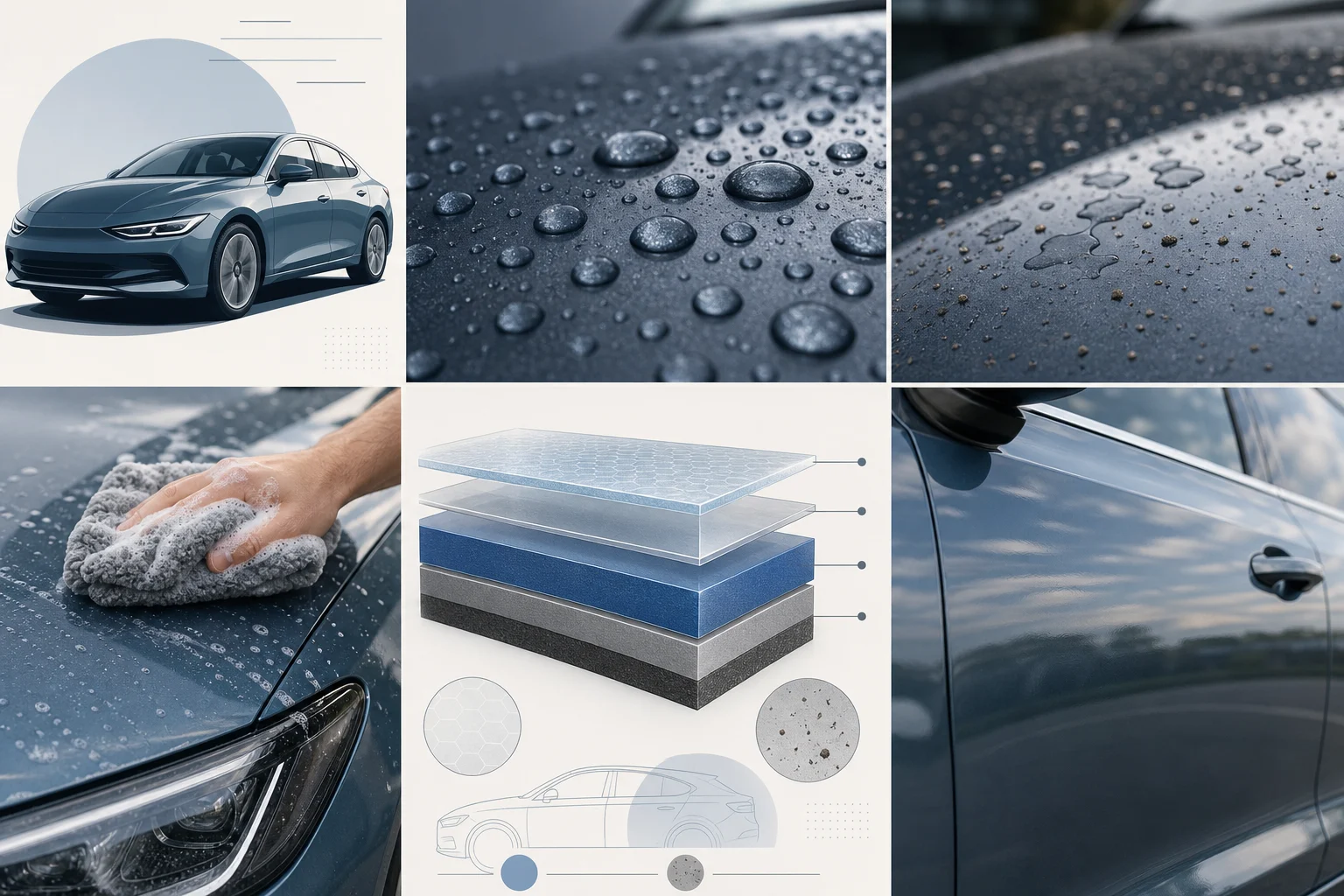
Picture two hypothetical owners at a kitchen table. One has a lease-return date marked on the calendar. The other keeps a notebook for a car they expect to drive for years. Both want clean, presentable paint, but they have different opportunities to benefit from a ceramic coating. The relevant question is not which owner cares more. It is how often each will wash the car, what result each expects, and whether the coating’s surface behavior will matter often enough to justify the preparation and upkeep.
Most of a coating’s practical value appears during ordinary care. If contamination releases with less repeated washing, water is easier to clear during drying, or the finish stays closer to the owner’s preferred appearance after a proper wash, those modest differences may become useful through repetition. A long-term owner who washes regularly has more chances to experience them. Someone expecting to change vehicles soon may have fewer. Time alone proves little, however. Keeping a car for years while rarely cleaning it does not automatically make a coating valuable, while a shorter-term owner with a disciplined wash routine may notice the benefit every week.
That is personal value, not a guaranteed financial return. A clean, carefully maintained finish may appeal to a future buyer, but a coating expense cannot be assumed to come back at sale or trade-in. Overall condition also includes impact damage, dents, interior wear, mechanical history, and washing defects that a thin surface layer does not control. Choose a coating because you expect its characteristics to improve your own routine, not because you are counting on a later owner to reimburse you.
Appearance standards need equally direct language. “Looks good” might mean presentable from a normal viewing distance, with ordinary chips and fine marks accepted. It might mean consistently glossy after washing. A stricter owner may want few visible defects under direct light, while near-show expectations turn tiny marks and dried residue into problems requiring attention. Each standard changes the sensible amount of preparation. A working daily driver need not be corrected toward perfection simply because it will be coated. Conversely, applying a coating over existing defects does not make those defects disappear.
The maintenance burden rises with the standard. A presentable car may need careful washing and prompt removal of obvious contamination. Consistent post-wash gloss puts more emphasis on complete cleaning and controlled drying. A low-defect finish depends heavily on keeping grit out of wash media and avoiding careless contact; a coating cannot compensate for dirty tools or aggressive technique. Near-show condition demands still more inspection and intervention because the owner is judging the paint under unusually revealing conditions, not merely using it as well-kept transportation.
Color and lighting can intensify that judgment. Dark paint may make dust, dried residue, or fine marks more conspicuous under some conditions. A focused inspection light can expose defects that are difficult to see outdoors from several steps away. Neither fact makes a particular paint color unsuitable for coating. It does mean that a highly attentive owner may experience more maintenance pressure than someone viewing the same finish less critically.
There is also emotional overhead. One owner may worry less because contamination feels more manageable and washing feels less laborious. Another may begin monitoring every bead, water spot, and change in slickness. Flattened water behavior can reflect surface contamination rather than immediate coating failure, yet an anxious owner may treat every change as evidence that something is wrong. Protection intended to simplify ownership can become another condition to police. That reaction is not trivial; it belongs in the decision alongside parking exposure and wash access.
Before choosing, run a horizon test. Write down how long you realistically expect to use the car and how often you have actually washed it over the past year. Name the recurring benefit you want: easier drying, less stubborn contamination, different water behavior, or a tidier finish after washing. Then estimate how many opportunities you will have to experience that benefit and whether you will keep using controlled wash and drying methods. A long-term owner satisfied with a presentable car may rationally maintain uncoated clear coat or use wax or sealant. A more demanding owner may prefer a coating, provided they accept that it will not prevent chips, deeper scratches, wash marring, or dried mineral residue. The sound choice is the routine whose benefits you will use and whose limitations you can live with.
A Decision Worksheet for Coated and Uncoated Daily Drivers
Consider two hypothetical owners with similar daily drivers. Owner A garages the car, washes carefully, notices fresh contamination, and plans to keep the vehicle. Owner B parks outdoors, uses whichever wash is convenient, dislikes paint upkeep, and may change vehicles sooner. The question is not which owner cares more. It is whether a ceramic coating changes a recurring task enough to justify the preparation and continued care each owner will realistically give it.
Owner A has a reasonable case for coating. The owner already uses the habits that support it, and may repeatedly benefit if grime releases more readily or rinsing and drying require less effort. Those improvements are useful precisely because they fit an established routine. The coating still cannot prevent stone chips, dents, deep scratches, or marks caused by grit dragged across the finish.
Owner B may reasonably maintain the clear coat directly or use wax or paint sealant. A coating would not move the car indoors, remove road film on its own, or control what contacts the paint during a convenience wash. It might instead give a maintenance-averse owner another surface behavior to monitor. Washing when practical, promptly addressing obvious contamination, and accepting ordinary wear can be the more coherent plan.
Neither profile is a rule. An outdoor-parked car may gain meaningful cleanup benefits when its owner washes consistently and responds to bird residue, tree debris, or dried mineral deposits. A garage-kept car may face little contamination and satisfy its owner with basic washing alone. Exposure creates occasions when a coating may help; behavior determines whether those occasions become real benefits.
Before choosing, write down specific answers to eight questions. What defects, chips, dull areas, or bonded contamination are present now? How much cleaning or correction is acceptable before protection? Where does the car usually sit? What wash method do you currently use, rather than hope to adopt? How quickly do you respond to contamination? What does good paint look like to you: presentable at normal distance or closely inspected under direct light? How long do you expect to keep the vehicle? Finally, can you accept that the chosen treatment will not stop impacts, chips, dents, deep scratches, or damage from careless contact?
If you choose a coating, establish an honest starting point. Clean and inspect the paint, then decide which defects are acceptable and whether correction is justified. After application, keep using clean wash media, sufficient lubrication, and controlled drying. Observe rinse behavior and drying effort across several washes instead of turning one patch of weak beading into a failure diagnosis. Contamination can mask surface behavior, so cleaning should come before conclusions about whether the coating remains effective.
Respond proportionately when the coated surface gets dirty. Remove fresh residue gently; do not scrub harder because a protective layer is present. Bonded material may require a dedicated cleaning step rather than repeated wash passes. Road film, dust, and dried minerals can still collect on the exposed surface. A coating may make some material less stubborn, but neglect can still leave marks or obscure the behavior the coating was meant to provide.
The uncoated path also deserves a written plan. Wash carefully so trapped grit and poor drying do not mark the clear coat. Remove suspect residue promptly, inspect periodically for bonded contamination and damage, and use wax or sealant if you want temporary changes in water behavior or cleanup. Refresh those products only when their benefits still matter to you. Forgoing a ceramic layer is not neglect; it means treating the clear coat as the working surface and accepting a more flexible maintenance routine.
The worksheet should produce a reason, not a product verdict. Complete this sentence with concrete details: “I am choosing this route because it changes this recurring part of ownership, and I accept that it will not prevent these other forms of damage.” If you cannot name the recurring problem, the work you will continue doing, and the limitation you accept, postpone the decision. Either coated or uncoated paint can be the sensible choice when the routine matches the owner.
A little more know-how.
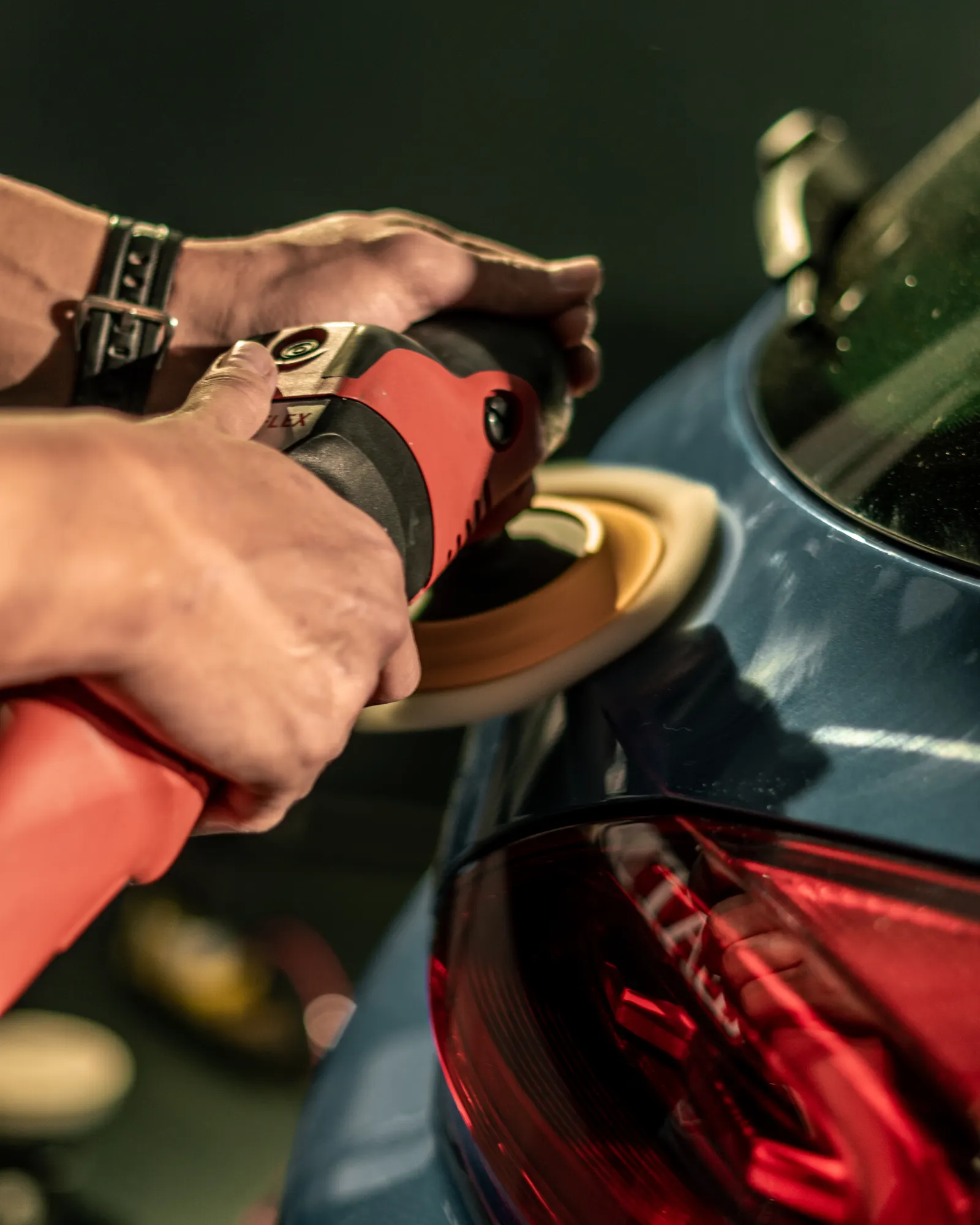
A detail or paint correction?
They solve different problems. Here’s how to tell which one your car might need.
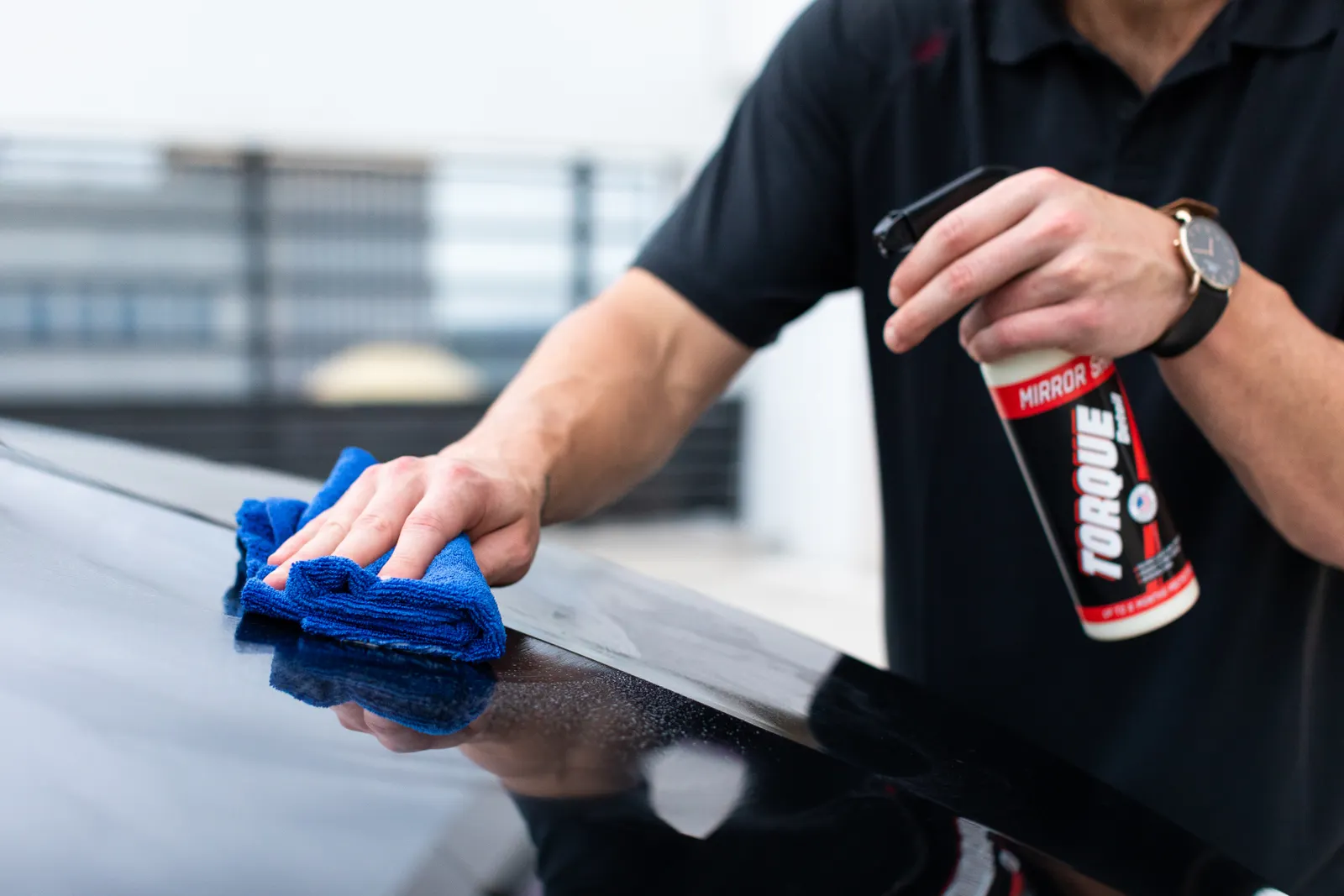
Keep your wrap looking right.
Washing, contamination, and the care instructions for your specific film.
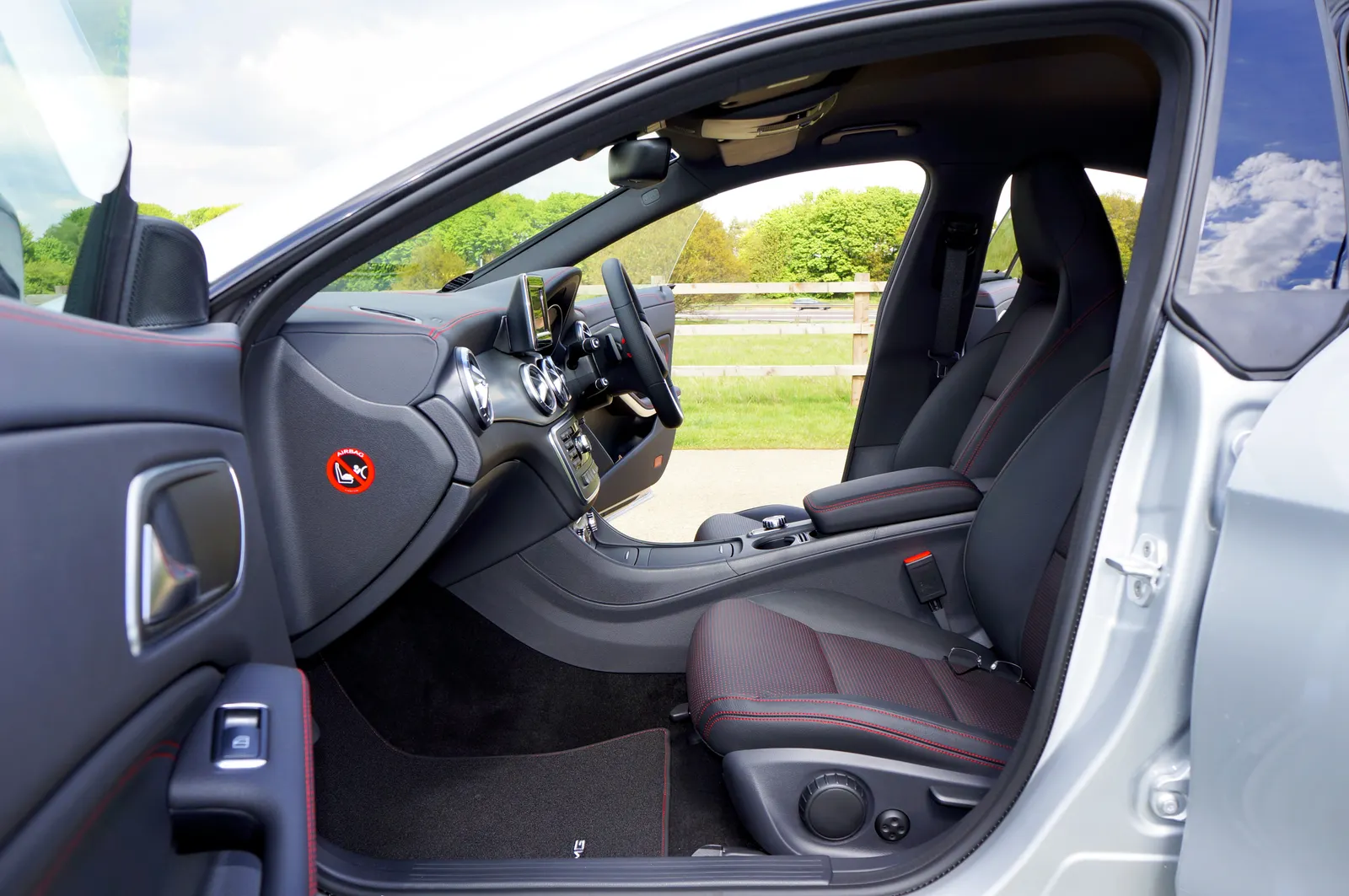
Before your detailing appointment.
A few useful details make it easier to plan the right service for your car.